Your finance team's data is different from marketing's contact list or sales' CRM dump. When a marketing email goes to the wrong address, someone misses a newsletter. When a payment goes to the wrong vendor, someone misses a mortgage payment.
The stakes are higher. The tolerance for error is lower. And yet, the same messy data problems that plague every department hit finance teams too. Duplicate vendor records. Inconsistent invoice formats. Amounts that don't add up. Dates that got mangled somewhere between the ERP export and the analyst's spreadsheet.
Most finance teams catch these errors eventually. The question is whether they catch them before or after the money moves.
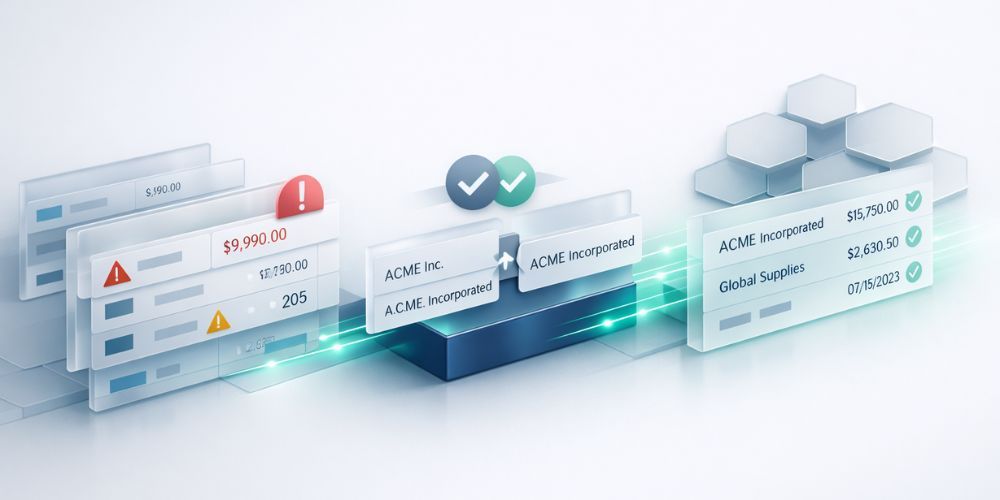
High-Risk Fields in Financial Data
Not all data fields carry equal risk. A typo in a vendor's DBA name is annoying. A transposed digit in a routing number is a wire transfer to the wrong bank account.
Finance data has specific fields where errors cost real money:
Payment amounts. An invoice for $15,000 that got entered as $150,000 isn't just a rounding error. Approval workflows, budget tracking, and cash flow projections all cascade from that single wrong number. And if it makes it past accounts payable without someone catching it, the correction process involves multiple departments, revised reports, and awkward conversations with leadership.
Vendor identification. When the same supplier appears as "Acme Technologies LLC," "ACME TECH," and "Acme Tech, LLC" in your vendor master, you lose visibility into total spend. Procurement can't negotiate volume discounts if they don't realize they're buying from the same company three times over. Worse, duplicate vendor records create openings for payment fraud, where fictitious vendors get created alongside legitimate ones and the duplicates provide cover.
Account codes and cost centers. A transaction coded to the wrong department might not trigger any immediate alarm. It just quietly distorts your departmental P&L until someone notices that marketing's software spend tripled while IT's dropped to zero. By the time the miscoding is discovered, the quarter is closed and restating gets complicated.
Dates. Invoice dates, payment due dates, fiscal period assignments. A payment booked to the wrong fiscal period doesn't just affect one report. It affects every downstream calculation that references that period. And date format confusion between US (MM/DD/YYYY) and international (DD/MM/YYYY) conventions has caused more silent financial errors than anyone wants to admit.
Duplicate Vendors and Duplicate Payments
This is where the money actually disappears.
Duplicate vendor records are more common than most finance leaders realize. They accumulate naturally: a new employee creates a vendor record without checking if one exists. An acquisition brings in an entirely separate vendor master. Someone enters "Microsoft Corp" while another person already created "Microsoft Corporation" months ago.
Each duplicate creates the possibility of a duplicate payment. If your AP team processes invoices against two separate records for the same vendor, the system treats them as two distinct obligations. The same invoice gets paid twice, or different invoices get paid without the context that they're from the same supplier.
According to the Association of Certified Fraud Examiners, billing schemes involving fictitious or duplicate vendors represent a significant portion of occupational fraud cases. Keeping your vendor master clean isn't just operational hygiene. It's a fraud prevention control.
The fix starts with deduplication, but it's not as simple as finding exact matches. Your vendor master contains abbreviations, legal suffix variations, typos, and format inconsistencies that make exact-string matching almost useless. "Johnson & Johnson" vs "Johnson and Johnson" vs "J&J" all refer to the same entity, but a basic matching algorithm wouldn't catch it.
Semantic matching, the kind that understands "Robert" and "Bob" are the same name, is what actually works here. Applied to vendor names, it can identify that "Acme Technologies LLC" and "ACME TECH" are almost certainly the same company, especially when combined with matching on address or tax ID.
Anomalies in Amounts and Dates
Anomaly detection in financial data is part math, part pattern recognition, and part institutional knowledge.
Some anomalies are obvious: a negative invoice amount, a payment dated in 1970 (classic Unix epoch error), or an expense report claiming $50,000 for office supplies. These are easy catches that any validation rule can handle.
The trickier anomalies hide in plain sight. A vendor whose average invoice runs $3,000 suddenly submits one for $30,000. That could be legitimate, maybe they expanded the scope of work. Or it could be a decimal point error, a fraudulent charge, or a duplicate amount that slipped through.
Effective anomaly detection doesn't just check whether a value is technically possible. It checks whether a value is typical given the context. What's the normal range for this vendor? What's the standard deviation of payments in this cost center? Does this invoice amount match the pattern established by the previous 50 invoices from the same supplier?
Date anomalies deserve special attention for finance teams. Backdated invoices, payments posted to prior periods, and suspicious timing patterns around quarter-end all warrant scrutiny. A cluster of large invoices arriving on December 30th might be coincidence. It might be channel stuffing. Anomaly detection helps you ask the right questions.
Controls and Approvals That Scale
Manual review doesn't scale. This is the uncomfortable truth every growing finance team confronts.
When you had 200 vendors and 500 invoices per month, a senior AP clerk could eyeball the data for problems. At 2,000 vendors and 5,000 invoices, that same clerk is just skimming. At 20,000 vendors, nobody is reviewing anything individually. They're processing.
Automated controls fill the gap between "we check everything" and "we hope for the best." But the key word is automated. Sending an email reminder to "please double-check vendor records quarterly" is not a control. It's a suggestion that will get ignored during busy periods, which is when errors are most likely.
Effective financial data controls include:
Standardization on ingest. When new vendor records, invoices, or transactions enter the system, they should be cleaned automatically. Phone numbers formatted. Names standardized. Amounts validated against expected ranges. This prevents bad data from accumulating in the first place.
Continuous duplicate monitoring. Not a one-time cleanup, but ongoing detection that catches new duplicates as they're created. When someone tries to add "Acme Tech" and "Acme Technologies LLC" already exists, the system should flag it before a second record is established.
Statistical anomaly flagging. Rather than setting rigid thresholds (reject anything over $10,000), use statistical baselines that adapt to actual patterns. A $10,000 payment might be perfectly normal from one vendor and wildly unusual from another. Context-aware flagging reduces false positives, which matters because too many false alarms train people to ignore all alarms.
Audit trails. Every change, correction, merge, and override should be logged with who did it, when, and why. When the auditors show up, and they will show up, having a complete record of data modifications turns a stressful exercise into a routine one.
A Case in Point: The Vendor Consolidation
Consider a mid-size manufacturing company running separate ERP instances for its US and European operations. After a merger, the combined vendor master contained roughly 12,000 records across both systems.
A typical approach would involve exporting both lists, manually reviewing them in Excel, and trying to find duplicates by sorting and scanning. For 12,000 records, this would take weeks of analyst time, and it would still miss matches where the naming conventions differed between the two ERPs.
The smarter approach: run both exports through an automated cleaning pipeline. Standardize company names and addresses first. Then apply semantic matching to identify duplicates across the two lists. Flag potential matches for human review rather than auto-merging, because finance teams rightfully don't trust black-box decisions about vendor records.
The result in scenarios like this is typically a 15-25% reduction in the combined vendor master, a measurable decrease in duplicate payment risk, and a clean foundation for the unified system. What would have taken weeks of manual work compresses into days, with better accuracy.
This is the kind of work CleanSmart was built for. SmartMatch identifies duplicate vendors using semantic similarity, catching the abbreviations and legal suffix variations that exact matching misses. AutoFormat standardizes the formatting inconsistencies that accumulate across systems and geographies. LogicGuard flags statistical anomalies in amounts and dates, surfacing the records that deserve human attention. And everything gets logged in a complete audit trail, because in finance, "trust but verify" isn't optional.
Getting Ahead of the Errors
The most expensive data errors in finance are the ones you discover after the books close. Restating financials, correcting vendor payments, and unwinding duplicate transactions all cost more in time, reputation, and actual dollars than catching the problems upstream.
Data cleaning for finance isn't a one-time project. It's an ongoing capability. The vendors keep coming. The invoices keep arriving. The potential for errors regenerates constantly.
The teams that handle this well don't rely on heroic manual effort. They build systems that catch problems automatically, flag genuine anomalies without overwhelming reviewers with false positives, and maintain the kind of audit trail that makes compliance a non-event.
Start with your vendor master. It's where the highest-risk duplicates live and where cleaning produces the most immediate ROI. Then expand to invoice validation, payment monitoring, and cross-system reconciliation.
Clean data won't make your finance team's job easy. But it will stop making their job unnecessarily hard.
How often should finance teams clean their vendor master data?
At minimum, quarterly. High-volume organizations processing thousands of invoices monthly benefit from continuous monitoring that catches duplicates as they're created rather than after they've caused problems. The cost of ongoing cleaning is a fraction of the cost of even one significant duplicate payment.
What's the difference between data validation and anomaly detection for financial data?
Validation checks whether data meets defined rules: Is this a valid account code? Is this date in the correct format? Does this field contain a number? Anomaly detection goes further by comparing data against historical patterns: Is this invoice amount unusual for this vendor? Is this payment timing consistent with the established pattern? Both are necessary, but anomaly detection catches the errors that pass validation because they're technically valid but contextually wrong.
Can automated data cleaning tools handle the complexity of financial data?
Yes, with the right approach. The key is that automated tools should flag and suggest rather than silently auto-correct. Finance teams need visibility into every change, the ability to approve or reject suggestions, and a complete audit trail. Tools that operate as black boxes, where data goes in and different data comes out with no explanation, aren't appropriate for financial data. The goal is augmenting human judgment, not replacing it.