
The Data Quality Signal - April 2026 Edition
Market Holds at 72.3 Despite Spring Stagnation
The Data Quality Signal composite index remained flat at 72.3 in April 2026, matching March's reading exactly. This marks the second consecutive month of zero movement in our aggregate measure, suggesting the market has entered a period of consolidation after the volatility seen in early 2026. The index components tell a story of balanced forces: search demand held steady at 94.6, while both interest momentum and content saturation remained locked at neutral 50.0 readings. This stability occurs against a backdrop of reduced content production, with article output dropping to 104 pieces from March's 108, indicating publishers may be taking a more measured approach to data quality coverage.
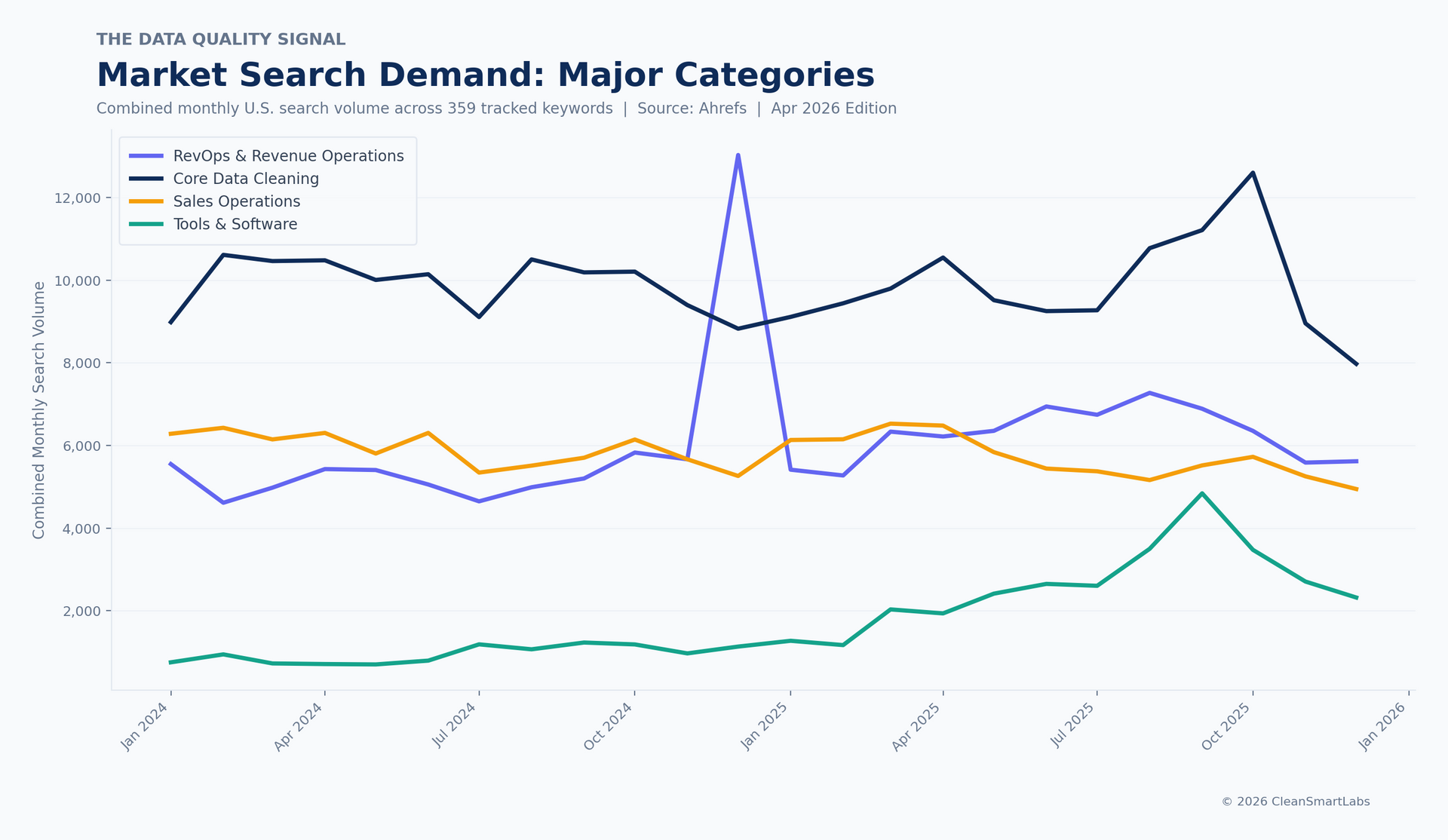
Category Peaks Signal Maturation in Core Segments
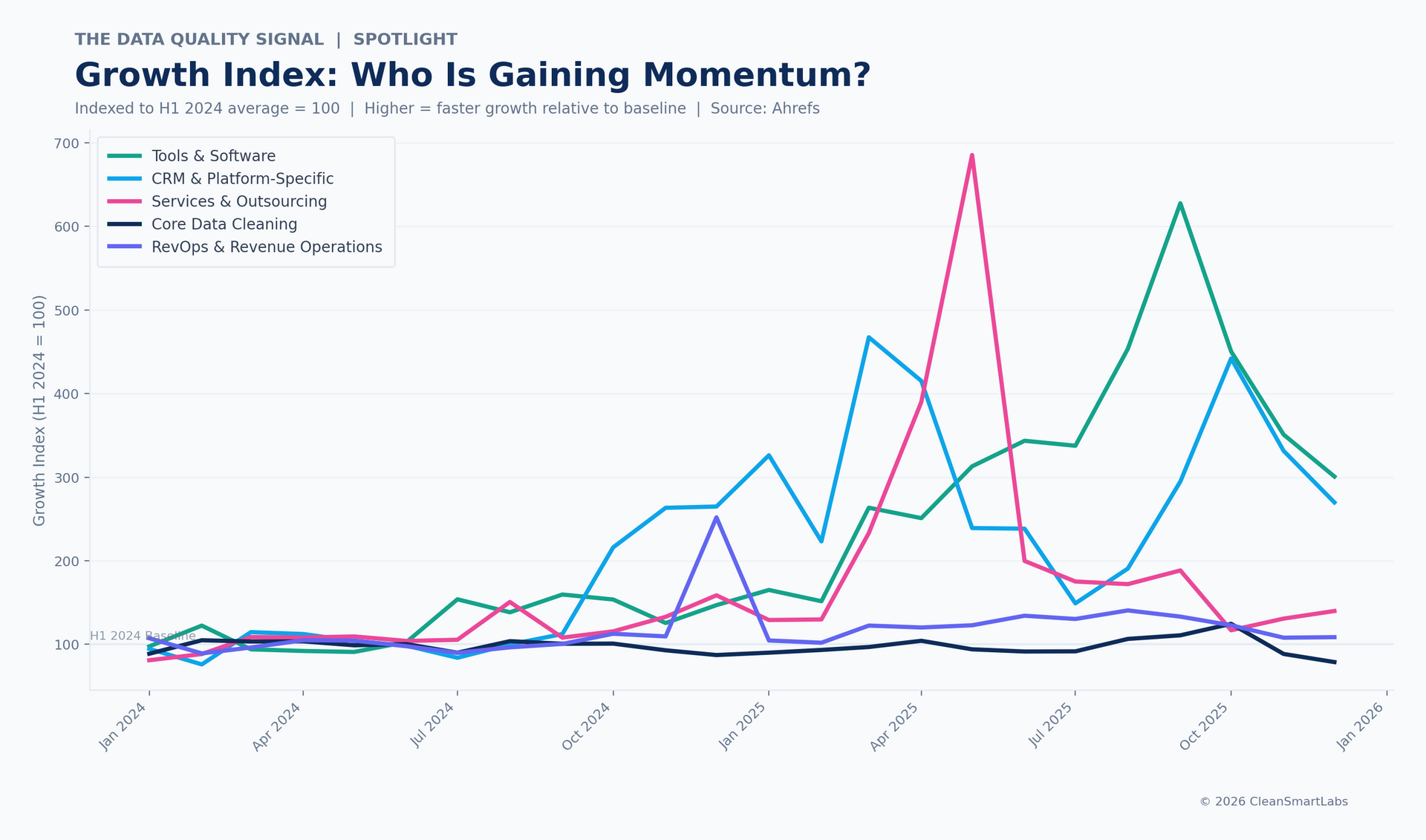
Three categories reached maximum scores of 100.0 this month: Tools & Software, RevOps & Revenue Operations, and CRM & Platform-Specific solutions. These perfect scores suggest these segments have hit peak interest within our measurement framework, likely reflecting market maturation rather than explosive growth. The Tools & Software category's ceiling performance aligns with the broader enterprise software consolidation trend we've tracked throughout 2026. Revenue operations continues to show institutional staying power, with 'revops' maintaining strong search volume at 3,000 queries monthly. The CRM category's peak score reflects the ongoing integration of data quality features into major platforms. Notably, no categories showed decline this month, a rare occurrence that supports the consolidation thesis. The absence of declining segments, combined with multiple categories hitting maximum scores, suggests the market may be approaching a saturation point in certain established areas.
Core Cleaning Terms Dominate Keyword Activity
Traditional data quality terminology commanded April's keyword landscape, with 'data cleaning' leading at 4,600 monthly searches. The semantic pair of 'data cleaning' and 'data cleansing' together captured 7,100 searches, reinforcing the continued relevance of foundational terminology over newer jargon. The 2,500-query volume for 'data cleansing' specifically suggests practitioners still engage with both variants of the core concept. Revenue operations vocabulary showed operational focus, with 'revops' (3,000 searches) and 'sales operations' (3,000 searches) indicating sustained interest in process-oriented applications. The appearance of 'data cleansing tools' at 1,000 searches reflects the practical implementation focus that has characterized 2026's market evolution. These keyword patterns suggest the market values established terminology and solution-oriented queries over conceptual or aspirational language.
Practitioners Face a Consolidating Landscape
The April data suggests practitioners are operating in an increasingly mature market where foundational approaches matter more than cutting-edge terminology. With multiple categories hitting peak scores and keyword activity centered on established terms, the focus should shift toward implementation quality rather than trend-chasing. Organizations evaluating data quality initiatives should prioritize vendors and approaches with proven operational track records over those promising revolutionary breakthroughs. The sustained strength in revenue operations terminology indicates cross-functional data quality projects continue to gain enterprise traction, making this an opportune time for practitioners to build bridges with sales and marketing teams. As we move into the traditionally active Q3 period, the market's current consolidation phase may give way to renewed innovation cycles, particularly in areas where adoption has reached critical mass.
The Data Quality Signal is published monthly by CleanSmartLabs. Each edition combines search volume data from 500+ keywords, Google Trends momentum, and publication activity across data cleaning, RevOps, and marketing operations into a single composite index. The result is a market-level view of where practitioner attention is shifting and what that means for teams managing business data.